Math Colored Icons: A Designer's Take on Stitching Clean Graphics
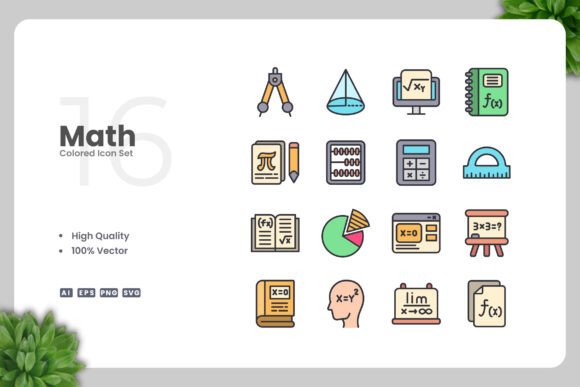
As someone who spends half their life staring at screens designing design assets and the other half hunched over an embroidery hoop, I approach new files with a specific kind of skepticism. When I first opened the Math Colored Icons package, my initial reaction was one of cautious optimism. The preview images promised simplicity and cleanliness—traits that usually translate well to thread, but can also spell disaster if the details are too fine. This isn't just a review of a digital file; it is an evaluation of how these Icons and Graphics hold up when subjected to the physical reality of needle, thread, and fabric tension.
The First Impression: Clarity in a Complex World
The visual personality of Math Colored Icons is immediately striking because of what it lacks: clutter. In the world of machine embroidery design, less is often more. These designs rely on bold shapes and clear lines, which suggests they were created with versatility in mind. The mood they create is educational yet playful, making them perfect for projects that need to feel approachable rather than intimidating. For a designer, this means the layout is likely forgiving. The theme is universal, appealing to teachers, parents, and students alike. However, seeing a vector on a monitor is one thing; imagining it as a finished product stitched onto a textured surface is another. My first thought was whether the "clean" aesthetic would survive the inherent texture of embroidery stitches without looking muddy.
Real-World Application: The Custom Tote Bag Test
To truly gauge the value of this embroidery file, I mentally walked through a real-life scenario that many Etsy sellers and craft business owners face daily: creating a custom back-to-school tote bag. Imagine a canvas tote, natural or navy blue, destined for a middle school math teacher. Placing one of the Math Colored Icons in the center creates an instant focal point. Because the design is described as simple, it avoids the common pitfall of becoming a stiff, cardboard-like patch on flexible fabric.
In this context, the thread colors become critical. Since the original description highlights the ability to easily edit colors in vector software, a professional would likely adjust the palette to match specific school colors or brand guidelines before digitizing or stitching. If you are using pre-digitized files, you must ensure the contrast is high enough. A light blue calculator icon on a grey sweatshirt might look great on screen but vanish in person. For a personalized gift or a small shop product, this level of scrutiny is what separates amateur work from boutique quality. The design's simplicity allows it to shine on a tote bag design without overwhelming the material, ensuring the recipient actually wants to carry it.
Versatility Across Products
Beyond tote bags, the potential applications for Math Colored Icons are vast. I can easily see these working as sweatshirt embroidery for a university STEM club, where a clean logo on the chest looks professional and cohesive. They are also ideal for baby embroidery projects, such as bibs or onesies, provided the scale is adjusted correctly. A tiny protractor or ruler icon adds a cute, intellectual touch to nursery decor without being overly busy. For holiday embroidery gifts, like a personalized apron for a baker who loves numbers, these graphics offer a unique twist on traditional motifs. Even for commercial embroidery projects, such as branding for a tutoring center, these Icons provide a consistent visual language that builds trust and recognition.
Navigating Technical Challenges
While the design is promising, practical experience dictates that we proceed with caution in certain areas. The description mentions these are perfect for print and web, which implies they may originate as vector Graphics intended for infinite scalability. When translating this to an embroidery project, the limitations of the machine come into play.
First, consider the hoop size. If you are attempting to stitch these onto a curved surface like a cap, the hoop space is limited. You must ensure the design fits comfortably without hitting the frame edges, which can cause skipped stitches. Second, think about fabric texture. On a plush towel or a thick fleece blanket, fine details can get lost. If the Math Colored Icons rely on thin running stitches to define edges, they might sink into high-pile fabrics. In such cases, a heavier stabilizer is non-negotiable to keep the design crisp.
Dark fabrics present another hurdle. If the design includes open spaces or relies on the background color to define shapes, stitching it onto black denim requires careful planning. You may need to add a satin stitch border or increase the stitch density to prevent the dark fabric from peeking through and muddying the colors. Furthermore, if the design includes any tiny lettering or intricate corners, these are the first areas to fail under the stress of frequent washing. For items like kitchen towels or children's clothes that will see heavy use, durability is key.
Designer Notes for Best Results
Before committing to a final run, there are several steps every apparel decorator and handmade product creator should take. First, always test the design on scrap fabric that matches your final material. This reveals how the fill stitch and satin stitch elements interact with the weave. Check the thread color contrast under different lighting conditions; what looks vibrant in the studio might look dull in natural light.
It is also wise to view the design in black and white mockups. This strips away the distraction of color and lets you judge the structural integrity of the shapes. Does the icon still read clearly? If not, adjustments are needed. Confirm the licensing terms explicitly. While the description suggests ease of editing, you must verify if the license permits commercial embroidery sales or if it is restricted to personal use. This is crucial for digital product sellers and creative entrepreneurs who want to avoid legal issues down the line.
Finally, consider the end user. Will this embroidered patch or direct stitch withstand the rigors of daily life? If the stitch density is too low, the item may look cheap. If it is too high, the fabric might pucker. Balancing these factors ensures that the Math Colored Icons enhance the product value rather than detract from it. By treating these Graphics with the respect they deserve and applying rigorous testing, you can transform a simple digital download into a cherished handmade product that customers trust and love.