Review: 34 Hand Drawn Arrows Doodle Vector for Embroidery
As a designer who spends more time staring at stitch simulations than actual sleep, I approach new design assets with a healthy dose of skepticism. We see thousands of files claiming to be versatile, but few hold up when the needle hits the fabric. Today, I am evaluating the 34 Hand Drawn Arrows Doodle Vector. While this collection is marketed primarily as Icons and Graphics for digital presentations and social media, my interest lies in its potential translation into a tangible machine embroidery design. Can these sketch-style illustrations survive the transition from screen to thread without losing their charming, imperfect personality?
The Aesthetic: Imperfection as a Feature
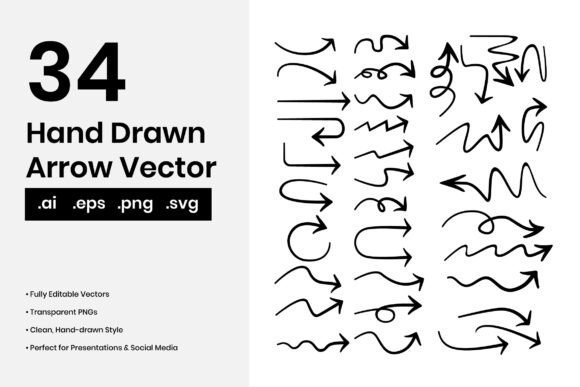
The first thing that strikes me about the 34 Hand Drawn Arrows Doodle Vector is its mood. These are not rigid, geometric vectors; they possess a loose, organic flow that mimics a quick pen sketch. For an embroidery project, this is actually a massive advantage. Perfectly straight lines often look sterile on fabric, whereas a slightly wobbly line can feel intentional and handmade. The visual personality here screams "boutique" and "artisan," making it an ideal candidate for brands that want to avoid the mass-produced look of big-box retail.
However, translating a vector graphic into an embroidery file requires careful digitizing. The sketch style relies on varying line weights and open spaces. If a digitizer fills these shapes with dense fill stitch patterns, the delicate doodle aesthetic will vanish under a block of thread. To maintain the integrity of the original Graphics, these arrows should ideally be rendered using running stitch or light satin stitch columns. This approach preserves the airy, hand-drawn feel while ensuring the stitch density remains low enough for comfortable wear on custom apparel.
Real-World Application: The Tote Bag Test
To truly understand the value of this collection, I imagined a specific real-life scenario: a small shop owner preparing a run of canvas tote bags for a spring market. The goal was to create a handmade product that felt personal and whimsical. I selected a few directional arrows from the 34 Hand Drawn Arrows Doodle Vector set to create a scattered pattern near the bottom corner of the bag.
In this context, the design shines. Canvas has a distinct fabric texture that can sometimes fight against overly detailed embroidery, but the bold, simple strokes of these doodle arrows sit beautifully on the weave. The lack of intricate shading means the thread colors pop without muddying together. For an Etsy seller, this kind of design adds perceived value. It looks like a custom illustration rather than a clip-art stamp. Customers are drawn to items that feel unique, and the irregular lines of these arrows suggest that human touch that drives sales in the craft community.
Beyond tote bags, I can see these working exceptionally well for sweatshirt embroidery. A single, large arrow placed on the sleeve or chest of a fleece hoodie creates a trendy, streetwear vibe. Because the design is essentially line art, it remains flexible and doesn't create a stiff, cardboard-like patch on the garment, which is crucial for comfort in baby embroidery or casual wear.
Technical Considerations and Fabric Challenges
While the aesthetic is promising, practical application requires caution. Not every surface is friendly to sketch-style designs. If you are working with stretchy fabrics like jersey knits for t-shirts, the open nature of a running stitch design can lead to distortion if not properly stabilized. You must use a high-quality cut-away stabilizer to prevent the stitches from sinking into the fabric or puckering over time. This is especially true for products that need frequent washing, such as kitchen towels or aprons.
Another critical factor is the hoop size. Some of the arrows in the 34 Hand Drawn Arrows Doodle Vector collection feature long, sweeping tails. If you attempt to stitch these on a curved surface like a cap, you may run into framing issues unless the design is broken down or resized significantly. Furthermore, on dark fabrics, a simple outline might get lost. In these cases, you might need to adapt the concept into an applique design, using the vector as a cutting guide for a contrasting fabric patch, then stitching around the edge. This adds texture and ensures visibility on navy or black garments.
Small details also demand attention. If the original vector includes very fine cross-hatching or tiny decorative dots, these might not translate well to thread. A digital embroidery file needs to simplify these elements. Before committing to a production run, always test the design on scrap fabric identical to your final material. Check how the start and stop points are handled; in a doodle style, visible jumps can ruin the illusion of a continuous hand-drawn line.
Commercial Viability and Brand Consistency
For creative entrepreneurs, consistency is key to building trust. The 34 Hand Drawn Arrows Doodle Vector offers a cohesive library that allows for varied yet unified branding. You could use one arrow style for a logo mark on a hat and a different variation for a hangtag or packaging insert. This cross-platform consistency strengthens brand recognition. When a customer sees the same whimsical arrow style on your website's printable mockup and the actual finished product they receive, it reinforces professionalism.
However, a word of warning regarding licensing: since this product is described as a vector collection for digital content, you must verify the license terms before selling physical goods. Many graphic bundles are licensed for digital use only. To use these safely in a craft business for commercial embroidery, you may need to purchase an extended license or ensure the creator explicitly allows physical resale. Never assume a digital asset grants automatic rights for mass production.
Final Verdict for Makers
The 34 Hand Drawn Arrows Doodle Vector is a strong contender for designers looking to inject personality into their work. Its strength lies in its simplicity and its ability to mimic the human hand. When digitized correctly with appropriate stitch types and density, it elevates standard items like pillow covers, tea towels, and baby onesies into giftable, boutique-quality pieces.
My advice to fellow makers is to embrace the imperfections of this style but respect the technical limits of embroidery machinery. Test your thread color contrast rigorously—a black thread on white cotton is classic, but try muted earth tones or pastels to enhance the "doodle" vibe. Whether you are creating a personalized gift for a friend or stocking inventory for a holiday market, these arrows provide a versatile foundation. Just remember to check the specific file formats and hoop requirements before you hit start, ensuring that the charm of the sketch survives the journey from vector to stitch.